
20 November 2026
Does South Bopal Flood? The ₹142 Crore Drainage Plan
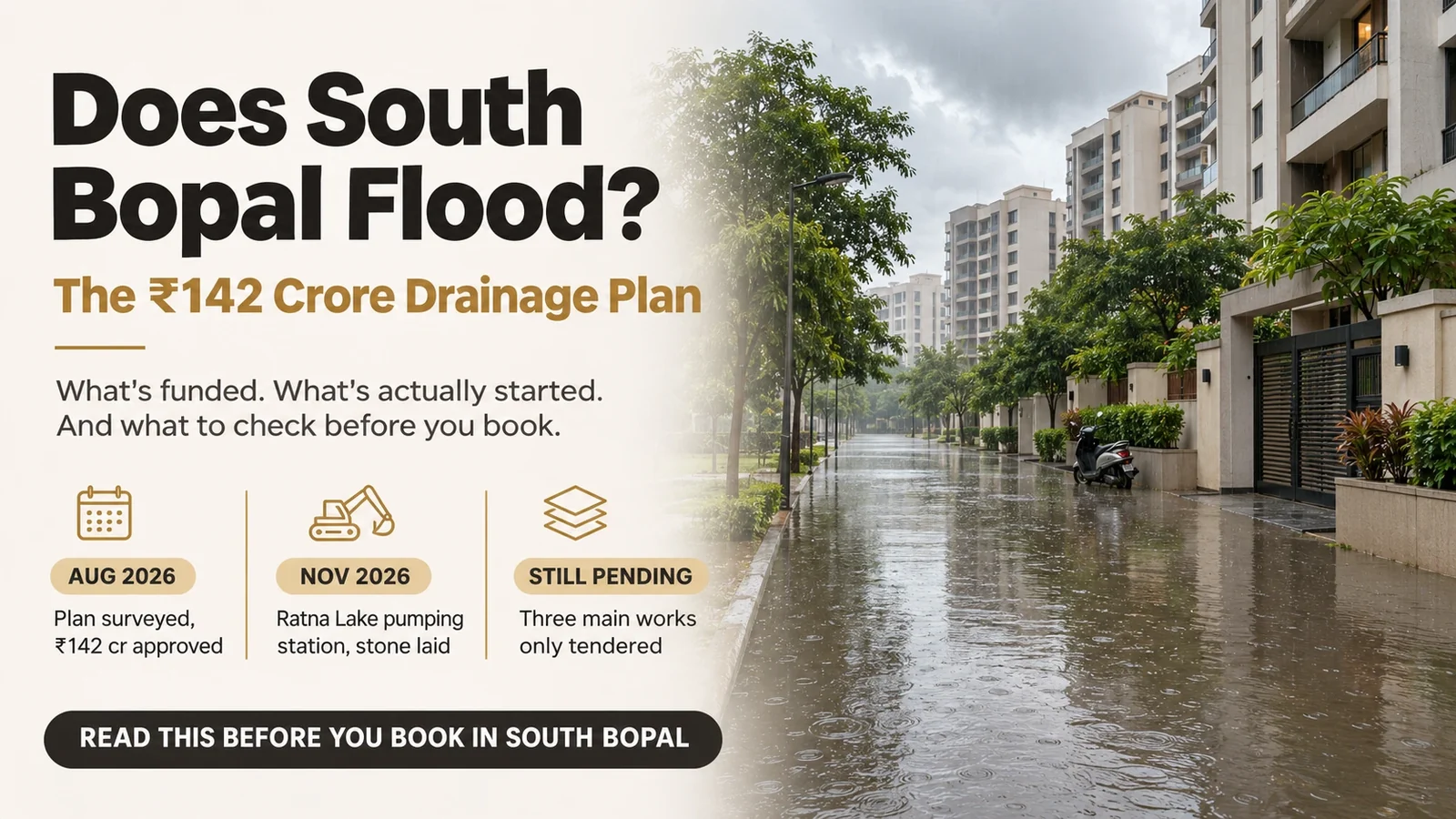
Yes, parts of it did this monsoon. Residential societies across Bopal and Ghuma were left waterlogged after heavy rain, and that is the honest starting point for anyone buying in South Bopal. The useful question is not whether it happened. It is what is being done about it, how far along that actually is, and what you can check on the specific building you are considering.
What happened, and why here
Ahmedabad took around 18 inches of rain earlier in the monsoon season, and several residential societies in the Bopal-Ghuma area were left waterlogged, according to DeshGujarat’s report of 13 August 2026.
The reason this belt in particular struggles is not mysterious. Bopal, Ghuma, Ambli and Shela were only brought inside the Ahmedabad Municipal Corporation's limits in 2021. Before that they grew fast, under a different authority, and a lot of what was built went up ahead of the municipal stormwater network that would normally come first. The drainage is catching up with the construction rather than the other way round.
That is a real problem and it is worth saying plainly, because it is the thing a first-time visitor to the area in January will never see for themselves.
What the AMC has actually announced
The corporation has announced three stormwater drainage projects worth ₹142 crore for the Bopal-Ghuma area. According to the AMC, the projects cover around 710.55 hectares across the Bopal, Ghuma and Ratna Lake catchments, within a wider plan covering a catchment of about 11.50 sq km that is expected to benefit roughly 3.5 to 4 lakh residents.
The works proposed are new stormwater lines, catch pits, interconnections and outfalls in areas where the drainage network is currently inadequate or absent. A new stormwater pumping station at Ratna Lake is also planned, to move excess rainwater collected in the lakes out faster. That is the one piece of this that has since started.
The money comes through the National Disaster Management Authority framework, shared 60:40 between the NDMA and the Gujarat government.
It sits inside something larger. The AMC carried out a hydrological survey of the whole Ambli-Bopal-Ghuma-Shela belt and prepared a zone-wise stormwater drainage master plan, which also proposes longer-term work along the Gota-Godhavi Canal and the Sabarmati River. The corporation says the network has been designed with future population growth in mind, which for an area still filling up is the part that matters most.
What changed in November 2026
On 9 November 2026 the foundation stone was laid for a stormwater pumping station at Ratna Lake in Bopal-Ghuma, together with a 1,400 mm rising main. The station is estimated to cost ₹23.95 crore, and it was one of six projects worth ₹382.08 crore whose foundation stones were laid that day, inside a wider Ahmedabad programme of around thirty projects worth more than ₹1,400 crore.
Union Home Minister Amit Shah, who laid the stones, attached a date to it. Speaking about the homes that flooded in Bopal-Ghuma, he said that before he came back to seek votes in 2029 he would put a system in place so that "even if 25 inches of rain fell, water would not enter their homes", and that work towards that promise had begun that day. Chief Minister Bhupendra Patel put it more plainly: “work on that project is beginning today”.
That is a real change from August, and it is the most useful single fact in this piece. Ratna Lake is the station the August plan listed as merely planned. It now has ground broken on it, and a commitment attached to a named year and a specific rainfall figure, which is a considerably harder thing to walk away from than a line in a master plan.
The part most coverage leaves out
One pumping station having its foundation laid is not the same as the drainage being fixed, and the distance between those two things is where most of the selling happens.
The three stormwater works that make up the ₹142 crore had tenders invited as of the AMC's August 2026 announcement. No award has been reported since, and no completion date has been published for any of them. Nor does any of the reporting, in August or in November, say that the ₹23.95 crore pumping station is paid for out of that ₹142 crore. They are two figures sitting under the same master plan, and that is as much as the public record supports.
This matters because you will see the ₹142 crore quoted at you, including by people selling flats, in a way that makes it sound like the problem is already solved. What exists today is a surveyed, funded, tendered plan with one component under way. That is considerably better than nothing. It is not the same as a working drain outside your building.
If somebody tells you the drainage is "done", ask which work they mean and when it was commissioned. The answer will tell you how careful they are being with everything else they have told you.
Five things to check on the actual building
A municipal plan covers a catchment. It does not tell you about one plot. These are the checks that do, and they work on any project in the area, including ours.
1. The plinth level against the road. Most waterlogging inside a society is a level problem before it is a drainage problem: if the road outside has been raised over the years and the plinth has not, water runs in. Stand at the gate and look at where the road sits relative to the ground floor. You do not need an instrument to see a bad one.
2. Where the project's own stormwater goes. Every project has internal stormwater lines. Ask where they discharge, and whether that outfall connects to a municipal line that exists today or to one in the master plan. Those are very different answers.
3. What happened on the site this monsoon. If the project is under construction, somebody was on that plot in August. Ask what the site looked like. Ask the security staff rather than only the sales team, and ask neighbours in the societies either side, who have no reason to manage the answer.
4. The basement, if there is one. Basement parking is where flooding stops being an inconvenience and starts costing money. Ask about the ramp level, the sump pump capacity, and whether there is a backflow arrangement on the drainage connection.
5. Who maintains it after possession. Catch pits silt up. A stormwater system is only as good as the cleaning schedule, and after handover that is the society's job, not the developer's. Ask what is being handed over and what the first year's maintenance covers.
And run the project itself through the Gujarat RERA register while you are at it. The approved plan filed there is the one the developer is bound to, drainage included.
None of these need a consultant. All five can be asked at a site visit, and a developer who answers them straight is telling you something useful about how they will answer everything else. Our piece on what to check before booking an under-construction flat covers the rest of that ground.
What this means if you are buying in South Bopal
The straight reading is that South Bopal has a known drainage problem, that the problem has been surveyed rather than guessed at, that ₹142 crore of central and state money has been committed against it, and that the first piece of work has now started while the bulk of it has not.
Whether that is good enough depends on your timeline. If you are buying something that hands over in 2030, the municipal work has four monsoons to get done and you are mostly betting on the plan. If you are buying something ready or nearly ready, the plan helps you less and the five checks above matter more.
It is also worth keeping in proportion. The same belt that struggles with water is the one absorbing the most new supply in the city: Cushman & Wakefield’s Q3 2026 figures put Ahmedabad at 7,380 residential launches for the quarter, with West Peripheral leading, driven by Shela and South Bopal. People are not moving here in spite of knowing the area. They are moving here and asking better questions about it.
We build four projects in South Bopal, so we are not a disinterested party on any of this. What we would say is that the checks above are the ones to run, and that they should be run on us as readily as on anybody else. If you want to see where our four sit, they are laid out side by side with their possession dates and RERA status on our builders in South Bopal page, and the area itself is covered in South Bopal vs Shela.
Sources
Every figure above comes from one of these. They are linked so you can check them rather than take our word for it.
AMC unveils Rs 142 crore stormwater plan to tackle waterlogging in Bopal-Ghuma – DeshGujarat, 18 August 2026. The ₹142 crore, the 710.55 hectares, the Ratna Lake pumping station, the NDMA 60:40 funding split, and the line that tenders had been invited.
AMC prepares storm water drainage master plan for Ambli, Bopal, Ghuma and Shela – DeshGujarat, 13 August 2026. The hydrological survey, the master plan, the 18 inches of rain, and the 2021 date these areas entered AMC limits.
From traffic relief to housing: Ahmedabad gets development projects worth ₹1,400 crore – Gujarat Samachar, 9 November 2026. The foundation stone for the Ratna Lake stormwater pumping station and its 1,400 mm rising main.
Amit Shah inaugurates and lays foundation stones for projects worth over ₹1,400 crore in Ahmedabad – ANI, 9 November 2026, and the same day’s IANS report in The Hans India and Eastern Mirror. The ₹382.08 crore across six projects, the ₹23.95 crore for the station, the 2029 pledge, and the Chief Minister on work beginning.
Ahmedabad MarketBeat – Cushman & Wakefield. The 7,380 residential launches in Q3 2026 and the note that Shela and South Bopal led supply.
Drainage Department, Ahmedabad Municipal Corporation – the department responsible for this work. Its page does not carry the project figures above; it is listed here as the authority to approach for the current position.
Gujarat RERA – where any project named here, ours included, can be checked.
The ₹142 crore plan and its figures come from reporting of August 2026, which describes those three works as tendered; the pumping station’s groundbreaking is from reporting of 9 November 2026. Status moves. Before relying on any of it, check the current position with the AMC.