
15 September 2026
What to Check Before Booking an Under-Construction Flat
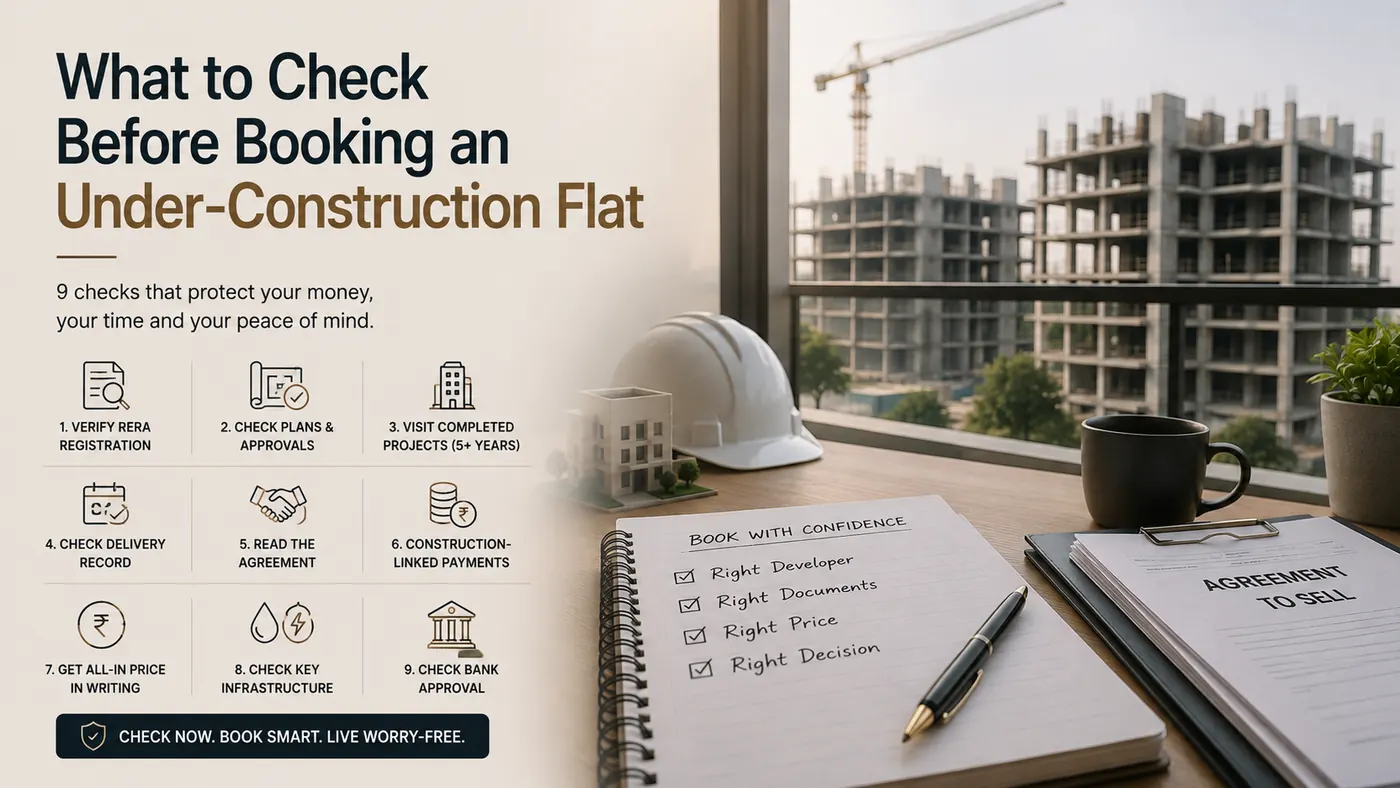
Buying an under-construction home means paying for something you cannot stand in. Done properly it is a perfectly sound decision - better pricing, first choice of unit, no GST-free premium on a ready flat, and time to arrange your finances.
Done carelessly it is the most expensive mistake a family makes. Here is the list.
1. Verify the RERA registration yourself
Not the number on the brochure - the entry on the portal. Go to gujrera.gujarat.gov.in, search the number, and read the listing.
Check that the promoter name matches the entity on your agreement, note the declared completion date, look at whether the project has been extended, and read the last few quarterly progress filings. Then search the promoter name separately for complaints.
Our step-by-step guide walks through the whole thing. It takes five minutes.
2. Read the approvals, not the brochure
Ask to see, and keep copies of:
The approved layout plan and building plan sanctioned by AMC or AUDA
The commencement certificate
The title documents and the land's ownership chain
Any NOCs - fire, environment, aviation where applicable
If a project is being sold before the commencement certificate exists, understand that you are taking on approval risk on top of construction risk.
3. Go and stand in something they finished five years ago
This is the most underrated check available to you, and it costs an afternoon.
Ask the developer for the address of a project they completed five or more years ago. Go there unannounced. Look at the lifts, the paint, the common areas, the water pressure, the parking. Then talk to a resident - anyone in the lobby will tell you the truth in three minutes.
A five-year-old building shows you what the developer actually builds. The sample flat shows you what their interior designer can do.
4. Check the delivery record, not the promise
Ask directly: which of your last three projects were delivered on the RERA-declared date, and by how much did the others slip?
You can verify the answer on the portal. A developer with a clean record will answer immediately. Hesitation is the answer.
5. Read the agreement before you pay
Ask for the draft agreement to sell before the booking amount, not after. Take it to your own advocate - not the developer's.
The clauses that matter most:
Possession date, stated as a date and not as "expected"
Delay compensation - what the developer pays you if they are late, and from when
Your exit terms - what you get back if you cancel, and the deduction
Carpet area variation - what happens if the delivered area differs from what was agreed
What triggers each payment - a construction stage, or a calendar date
That last one is important. Stage-linked payments protect you. Time-linked payments mean you pay whether or not the building is rising.
6. Insist on a construction-linked payment plan
Pay against progress. Foundation, then slabs, then finishing, then possession.
Be cautious about schemes that front-load your payment for a discount. The discount is real, but so is the risk - and you have given up your only meaningful leverage, which is the money you have not paid yet.
7. Get the all-in price in writing
The quoted price is rarely the price. Ask for a single written sheet listing:
Base price and the RERA carpet area it applies to
Floor rise charges
Car parking
Club or amenity charges
Infrastructure or development charges
Electricity and water connection charges
Maintenance deposit and advance maintenance
Society formation and legal charges
GST
Then divide the total by the carpet area. That is your real price per square foot, and it is the only number that lets you compare two projects honestly. See our note on carpet vs super built-up for why the brochure figure misleads.
8. Ask the unglamorous infrastructure questions
Water - municipal connection, or borewell? Is there a treatment plant, and who runs it?
Drainage - connected to the municipal network, or a private STP?
Power backup - for common areas only, or for individual flats too, and at what capacity?
Parking - is your allotted space specified in the agreement, covered or open?
Maintenance - what is the expected per-square-foot charge, and who runs it after handover?
These decide your monthly cost and your daily quality of life far more than the clubhouse renders do.
9. Check that a bank will fund it
Ask which banks have approved the project. A major lender's approval means their legal and technical teams examined the title and the approvals and were satisfied.
It is not a guarantee. But a project no bank will fund is a project worth asking hard questions about. The Park, for instance, is financed by Aditya Birla Housing Finance, which means its documentation has already been through an institutional review.
The short version
Verify the registration yourself. Read the agreement before you pay. Pay against construction stages. Get every charge in writing. And go and stand in something they built five years ago.
Do those five and you have removed most of the risk that makes under-construction buying frightening.
You are welcome to run all nine on us. Our teams at Good Earth, The Park, Proxima and Evara will hand you the documents rather than make you ask twice - and if you would rather see the whole purchase sequence first, our How to Buy guide covers enquiry through to possession.
Talk it through with someone who builds here
Resset has been building in Ahmedabad since 2006 - five communities across South Bopal, Shela and Telav, with 2,600+ families already living in them. If you want a straight answer about any of this against your own budget and timeline, book a site visit or call +91 99988 81927. No pressure, no scripts.